I have two offerings from the internet in honor of breast cancer awareness month. First, my sister found this website by a woman who, like me, chose no reconstruction and does not wear a prosthesis. I've written about my choices previously, which can be found here and here. The writings and the images on the Flattopper Pride website are pretty incredible. I love that so many of us are rocking the flatness that is our new, original self.
http://www.flattopperpride.org/
Also, a friend of mine sent me a recent article from the Washington Post on having hidden cancer. Like me, the author of the piece is living with a terminal diagnosis but outwardly appears to be a healthy human. She has brain cancer, I have lung cancer. She was given 2-18 years to live, my prognosis is "optimistic" with continued treatment indefinitely. She and I both live each day to its fullest potential with infrequent thoughts of our disease, until the quarterly scans remind us of our precarious position between sickness and health, inflicting doubt about our ability to live. It's a lovely article.
https://www.washingtonpost.com/opinions/i-have-cancer-but-i-sometimes-forget/2015/09/17/244dec30-5bca-11e5-9757-e49273f05f65_story.html
Tomorrow I am going to walk in the Race for the Cure with my family. I walked it for the first time last year only three weeks after my mastectomy. I'm excited to be a part of the excitement again this year, and this time with a clean bill of health. Maybe I'll see you down there! :)
Showing posts with label reconstruction. Show all posts
Showing posts with label reconstruction. Show all posts
Friday, October 2, 2015

Tuesday, October 28, 2014
Symmetry
My scar is pretty much sealed up now, with only about an inch of a deep scab remaining to fall off. The itching has transitioned from obtrusive rashes to a healing twinges. I have resumed my weekly yoga class, and I already have better range of motion in my right arm (surgified 7 weeks ago) than my left arm (surgified and irradiated 3.5 years ago). I daresay I'm healed. Efforts to improve strength and energy will now be the focus of my meditations.
All of my beautiful siblings! Even Ryan, who flew in from Seattle for the surprise. I have the best family ever. I love you guys.
Being physically healed has cleared the way for the next phase of healing, and that is the mental healing. Interestingly, adjusting to my breastless state has been much quicker and easier than my previous adjustment to having a single breast. I think that there are at least two reasons for this. First of all, I'm experienced in dealing with the emotional trauma that comes with losing a body part. Going through that loss a second time has been much less traumatic. Secondly, adjusting to my new body shape this time around is much less complicated than it was the first time. This has to do with the issue of symmetry. I spent a lot of time struggling with asymmetry after the first surgery, both psychologically and when shopping for clothes. The second mastectomy has returned me to a symmetric state, which I find suits my self-image. Perhaps I look oddly flat-chested to other people, but to me, I'm symmetric with no breast cancer. That look suits me.
Throughout this first phase of healing it has been important to wear loose clothing that doesn't constrict or pinch any parts of me. We want to ensure that the blood can flow to and lymph can drain from the sites of healing. Now that I'm past the itching and swelling, I can explore my options for undergarments. Clearly I don't need a bra, but some sort of torso-covering undergarment provides both warmth and comfort.
My friend J recently sent me an article about breast cancer survivors who started businesses to help fellow cancer patients and survivors, and one of the businesses sells appealing undergarments to women whose chests have been modified by cancer treatment. There probably was a time when I would have thought this sort of thing unnecessary ("Why not just wear camisoles? They are cheaper and cover more area," I may have said), but now that I am in this situation I am excited to have found someone who is actively creating a resource for people like me. Perhaps with a bit more shopping I'll decide that I don't actually need something necessarily bra-like, but a person does like to have options.
Speaking of options, I still have the prosthesis that I received after my first surgery. I think it's under my bed or something. I only wore it a handful of times. Soon I will be sufficiently healed to get a prosthesis for the other side, and then I will have yet another option for optimizing symmetry and self-image.
Finally, on a lighter note, guess who surprised me for my birthday on Friday?
 |
| Surprise! Happy birthday to me! Look how symmetric we are--there are two of each! |
Monday, November 19, 2012
I'm a flattie, and proud of it
I have previously written about my choice not to reconstruct after my mastectomy. I continue to be interested in this choice, and my interest is rooted in the fact that there must be hoards of other women out there who choose not to reconstruct. They seem to be hard to find and I rarely encounter them in person, but now some have been found electronically thanks to some recent online publications!
My friend S. and I have continued to research the variables that lead to and outcomes of the choice to be flat-chested after a mastectomy. Recently she interviewed me for articles on the websites Flyover Feminism and Mothering.com to align with IBC awareness week. Great job, S., and thank you for your efforts to raise the awareness of this important issue!
One of the articles received a comment from Melly with a link to another article. It's a great article. But even greater are the comments. Check out all of the positive feedback from other women who have chosen not to reconstruct. Of particular interest are the occasional insights into spousal support. Considering that women often feel pressured to reconstruct in order to remain attractive to their spouse, I think that some of the feedback here is particularly informative.
Happy reading!
Thursday, November 10, 2011
Image
"As I child I had expected my liberation to come from getting a new face to put on, but now I saw it came from shedding something, shedding my image."--Lucy Grealy in Autobiography of a face
I read the most remarkable book, cited above. Ms. Grealy was diagnosed with Ewing sarcoma in her jaw when she was nine years old. Her jaw was removed from one side of her face. She underwent 2.5 years of weekly, debilitating chemotherapy and a year or so of concurrent radiation. She survived.
The obvious and fascinating point of the book is to present what it is like to go through virtually your entire life, the teenage years in particular, with such a dramatically unique face. She underwent nearly 30 attempted reconstructive surgeries over 18 years. She developed numerous psychological tricks to cope with these physical and emotional hardships. In particular, she coached herself that she was ugly.
She decided that she had to tell herself that she was ugly in order to cope with the teases dished out by boys and men (at some point she states that girls and women never taunted her). The following is my interpretation, but it seems that rather than undergo an internal counter-argument, it was more effective for her to agree with them. I think I can understand this logic. If you tell yourself that you know you are ugly, a tease is no longer a tease but rather a pointless declaration of the truth. I can see it as a survival mechanism at the expense of one's self-esteem.
The hardest part to read about is her disappointment with the reconstructive surgeries. They all failed because her tissue was so severely irradiated that the transplanted tissue would not "take". It would simply be re-absorbed over the course of several months, and she would be left with her lack of a jaw line in spite of the lengthy, painful attempt to restore it. With each reconstruction, her hopes to no longer be "ugly" would rise, and with each failure she would recede farther from society.
In the end she had accepted an end to the surgeries. The last attempt seemed to have a slightly better cosmetic outcome than all of the previous attempts. But she couldn't reconcile that the face she saw in the mirror was actually her face. This is because she had gone her whole life looking the way one looks without half of a jaw, and now that it was at least partially corrected she didn't look like herself. But apparently she looked more acceptable to society? So as she tried to reconcile this paradox, she avoided looking at her reflection for over a year. Avoiding her face helped her accept that she had a face; she was no longer waiting for her face to be constructed.
It's a beautiful book with a universal message: you are beautiful.
"Why couldn't they just stop complaining so much, just let go and see how good they actually had it? Everyone seemed to be waiting for something to happen that would allow them to move forward, waiting for some shadowy future moment to begin their lives in earnest." --Lucy Grealy, Autobiography of a Face
I read the most remarkable book, cited above. Ms. Grealy was diagnosed with Ewing sarcoma in her jaw when she was nine years old. Her jaw was removed from one side of her face. She underwent 2.5 years of weekly, debilitating chemotherapy and a year or so of concurrent radiation. She survived.
The obvious and fascinating point of the book is to present what it is like to go through virtually your entire life, the teenage years in particular, with such a dramatically unique face. She underwent nearly 30 attempted reconstructive surgeries over 18 years. She developed numerous psychological tricks to cope with these physical and emotional hardships. In particular, she coached herself that she was ugly.
She decided that she had to tell herself that she was ugly in order to cope with the teases dished out by boys and men (at some point she states that girls and women never taunted her). The following is my interpretation, but it seems that rather than undergo an internal counter-argument, it was more effective for her to agree with them. I think I can understand this logic. If you tell yourself that you know you are ugly, a tease is no longer a tease but rather a pointless declaration of the truth. I can see it as a survival mechanism at the expense of one's self-esteem.
The hardest part to read about is her disappointment with the reconstructive surgeries. They all failed because her tissue was so severely irradiated that the transplanted tissue would not "take". It would simply be re-absorbed over the course of several months, and she would be left with her lack of a jaw line in spite of the lengthy, painful attempt to restore it. With each reconstruction, her hopes to no longer be "ugly" would rise, and with each failure she would recede farther from society.
In the end she had accepted an end to the surgeries. The last attempt seemed to have a slightly better cosmetic outcome than all of the previous attempts. But she couldn't reconcile that the face she saw in the mirror was actually her face. This is because she had gone her whole life looking the way one looks without half of a jaw, and now that it was at least partially corrected she didn't look like herself. But apparently she looked more acceptable to society? So as she tried to reconcile this paradox, she avoided looking at her reflection for over a year. Avoiding her face helped her accept that she had a face; she was no longer waiting for her face to be constructed.
It's a beautiful book with a universal message: you are beautiful.
"Why couldn't they just stop complaining so much, just let go and see how good they actually had it? Everyone seemed to be waiting for something to happen that would allow them to move forward, waiting for some shadowy future moment to begin their lives in earnest." --Lucy Grealy, Autobiography of a Face
Monday, October 10, 2011
Darn those things
I apologize for the inconvenience, but the IBC awareness proclamation signing has been moved to Thursday, October 27th at 1:45. Attendees should arrive 10 minutes before the signing. If you want to come, please RSVP to hollyasman at gmail dot com.
I continue to be amazed by society's lack of respect for breasts, real or fake. My friend Torey just sent me a link to this news article describing a woman who was embarrassed by airport security. She survived bilateral mastectomy and had tissue expanders in place prior to future reconstruction. This is a standard procedure for certain types of reconstruction because you can't just make a breast out of nothing; you either need to add tissue from other places or stretch the tissue that is there. For the latter procedure, a plastic surgeon inserts this hard, fill-able pocket under the pectoral muscles and gradually injects saline over the course of several weeks until the new "breast" is of the desired size. This is pocket is called a tissue expander, and it is replaced by a saline or silicone implant after the expansion is complete.
These tissue expanders must have looked unusual on the x-ray, perhaps even bomb-like, and this poor woman was more or less harassed about them although she had proper medical documentation. The officials did not allow her to present her documentation and insisted on feeling her up in front of the other passengers. I can think of so many reasons that this would be awful, public humiliation aside--the breasts themselves were probably quite sore, and the woman is in the midst of a difficult breast transition period both physically and mentally. Poor thing.
Isn't it ironic that her real breasts were real and cancerous bombs, but her reconstructed breasts were the ones accused of suspicious activities?
Thursday, September 22, 2011
Revealing
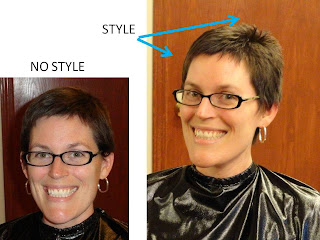
Martha totally called me out in the comments to the previous post. She said that she would like to see a picture of the new haircut with, well, more of the haircut in the picture. This is not an unreasonable request. I did not post awesome pictures of the haircut because the ones we took at the salon make me feel ridiculous. Also, now you'll know what my hair is Supposed to look like, although I have yet to achieve this level of stylishness with my own two hands. But at this point, what do I have to lose?

T9 vertebral body 1


One thing of which I was previously ignorant is the issue of styling your hair around the glasses stem. I used to just put on my glasses. Oh no no no no, not anymore. My stylist taught me how to use the comb to release the hair from the clutch of the stem, laying much of it gracefully over the top while leaving just enough underneath. Ah, short hair, will I ever pass all of your lessons?
While we are here, I will divulge that before my Herceptin therapy yesterday I got fitted for a prosthesis. I figured even if I never wear it, I may as well get fitted for it before I lose the prescription. The fitting was not unlike trying on shoes except that instead of taking off a shoe, I took off my shirt. Then the nurse who works in the Cancer Center Boutique helped me chose the correct prosthesis and try on countless bras. Choosing the prosthesis was the easy part because we just matched it to the existing breast. But I had to try on countless bras to find the right one for the right breast, the left prosthesis, and my 30-year-old self. See, the prosthesis requires a special bra that has a pocket in it. I guess you can't just set the prosthesis in a normal bra or it might just leap out of there. Because of this need for prosthesis security, these bras all seemed gigantic to me, and a far cry from my old bras. But whatever. It's not like I had cleavage or anything interesting before. Besides, I'm rather enjoying the no-bra lifestyle.
The prosthesis itself is made of silicone and is kind of cool; I will post pictures when it comes in. The nurse had to special order it because she didn't have any small enough for me. I always joked that my cup size was a lower-case A...turns out I wasn't far off the mark. I am indeed less than an A, but they call that size a double-A, not a lower-case A. So my double-A silicone breast is on order. I wonder if you can get those through Amazon?
Poke tally
port 38 (I only have two herceptin treatments left!!!!)
right arm 12
tummy 6
left arm 6
right breast 2++
left breast 1+
superior vena cava 1
Thursday, September 8, 2011
Evolution of a scar
I've been doing some reading lately about breast reconstruction. Not about the gross science-y stuff about reconstruction, but the social and psychological stuff. I'm not at all considering reconstruction, but now that I'm not in the thick of cancer treatment I've found myself curious about why women get reconstruction. Yea yea, isn't it obvious that the appearance of two breasts is better than one or no breasts? This is probably what I would have thought, if I had thought about it Before. But now that I've journeyed through the cancer treatment gauntlet, I'm not so sure.
First of all, surgeries are both painful and a pain in the a$$. Everything hurts, and continues to hurt long after the hurt is supposed to be gone. Electing for surgeries that are not a necessary part of cancer treatment is currently beyond my capacity.
Secondly, if I was uncomfortable with artificial body parts before, why should I suddenly be more comfortable now? Especially with a relatively expendable body part?
We all know, or at least have learned by now, that I am a practical person. The above viewpoints should therefore come as no surprise. However, I am in full support of other women choosing reconstruction. I am therefore trying to learn why they make this choice. My purpose is not to see if I'm right or wrong, but to learn about these other viewpoints.
In my small, non-scientific survey, I have found that the perception of others is the primary reason that women choose to reconstruct. I have determined this by reading dozens of anecdotes in numerous books. Most women want to look good (normal?) in clothes, and they want to be sexually attractive. What I find interesting about this is that it seems to me that retaining attractiveness is at their own expense, both in terms of potential medical problems with the reconstruction and the fact that the reconstructed breast often has no feeling. Did you know that latter fact, about the loss of feeling? It seems obvious, but I never thought about it before and I didn't know that. It seems to me that if I had no feeling in my reconstructed breast that that would be a constant reminder that it was for someone else and not me. Call me selfish, but I would hate that.
The other way of thinking about "wanting to look good in clothes" is a positive self-image. Many women state that they just don't feel like women without the appearance of two breasts. This underscores the importance of continued improvements in reconstruction technology and healthcare support. Also, mastectomy is not the only condition that might lead someone to opt for breast work. Reconstruction is a good choice for women who may psychologically struggle otherwise.
I'm sure there are others, but I've only read about one woman thus far with an attitude similar to mine. She thinks of herself as an Amazon, a strong and active woman who can now execute her life with improved physical prowess in the absence of a breast. I don't yet see myself as an Amazon, but I can relate to the improved functionality of my new physique.
Also, I'm learning to see the beauty in my asymmetry. I hold my head high and walk around with confidence. My spouse constantly affirms my beauty. I have bought a few new shirts that are asymmetric and complimentary. I can now see asymmetry everywhere in the world, and it has unusual beauty. I truly do not feel that I need a reconstructed breast.
My scar itself is also remarkable. It keeps changing. Will it ever stop? It started pink, then turned to white (perhaps because of radiation?), then pink with white in the middle, then red with white in the middle, and now a deep red. It's slightly raised in some places, yet exceedingly smooth in others. It itches sometimes. The evolution of my scar is symbolic of the psychological journey about breasts, sexuality, and beauty that I am on. Always interesting and never done changing.
First of all, surgeries are both painful and a pain in the a$$. Everything hurts, and continues to hurt long after the hurt is supposed to be gone. Electing for surgeries that are not a necessary part of cancer treatment is currently beyond my capacity.
Secondly, if I was uncomfortable with artificial body parts before, why should I suddenly be more comfortable now? Especially with a relatively expendable body part?
We all know, or at least have learned by now, that I am a practical person. The above viewpoints should therefore come as no surprise. However, I am in full support of other women choosing reconstruction. I am therefore trying to learn why they make this choice. My purpose is not to see if I'm right or wrong, but to learn about these other viewpoints.
In my small, non-scientific survey, I have found that the perception of others is the primary reason that women choose to reconstruct. I have determined this by reading dozens of anecdotes in numerous books. Most women want to look good (normal?) in clothes, and they want to be sexually attractive. What I find interesting about this is that it seems to me that retaining attractiveness is at their own expense, both in terms of potential medical problems with the reconstruction and the fact that the reconstructed breast often has no feeling. Did you know that latter fact, about the loss of feeling? It seems obvious, but I never thought about it before and I didn't know that. It seems to me that if I had no feeling in my reconstructed breast that that would be a constant reminder that it was for someone else and not me. Call me selfish, but I would hate that.
The other way of thinking about "wanting to look good in clothes" is a positive self-image. Many women state that they just don't feel like women without the appearance of two breasts. This underscores the importance of continued improvements in reconstruction technology and healthcare support. Also, mastectomy is not the only condition that might lead someone to opt for breast work. Reconstruction is a good choice for women who may psychologically struggle otherwise.
I'm sure there are others, but I've only read about one woman thus far with an attitude similar to mine. She thinks of herself as an Amazon, a strong and active woman who can now execute her life with improved physical prowess in the absence of a breast. I don't yet see myself as an Amazon, but I can relate to the improved functionality of my new physique.
Also, I'm learning to see the beauty in my asymmetry. I hold my head high and walk around with confidence. My spouse constantly affirms my beauty. I have bought a few new shirts that are asymmetric and complimentary. I can now see asymmetry everywhere in the world, and it has unusual beauty. I truly do not feel that I need a reconstructed breast.
My scar itself is also remarkable. It keeps changing. Will it ever stop? It started pink, then turned to white (perhaps because of radiation?), then pink with white in the middle, then red with white in the middle, and now a deep red. It's slightly raised in some places, yet exceedingly smooth in others. It itches sometimes. The evolution of my scar is symbolic of the psychological journey about breasts, sexuality, and beauty that I am on. Always interesting and never done changing.
Monday, July 11, 2011
Beautiful survivors
Maybe you've already heard, but former first lady Betty Ford passed away last Friday. She overcame some remarkable difficulties in her lifetime, including breast cancer and drug addiction. She founded a center to help people overcome their addictions. This of course is an excellent contribution to society, but I am naturally drawn to her courage in the face of breast cancer. She was a model for how high to hold your head during and after breast cancer treatment.
Another beautiful survivor I recently encountered is Matuschka. She became famous in 1993 when her self-portrait appeared on the cover of the New York Times magazine.
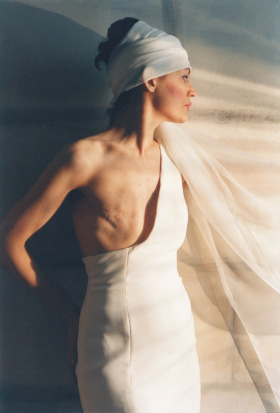
Isn't she amazing? Apparently this was a highly controversial photograph, and I am interested in reading more about the controversy because I don't see any place for controversy. I see nothing but beauty. Clearly I am biased. I'm guessing that the "damaged" part of her body is just more than most people want to see. I'd be interested in hearing what you think.
I was pleasantly surprised by her choice of wearing white. If it were me, and it might be someday because it would be fun to replicate this photoshoot, my instinct would have been to wear red. Red isn't even my color, but it would be dramatic and angry and representative of how I felt for a long time. In contrast, I love that the white dress represents purity despite the damage. The slim, angular dress adds an element of sexiness, and the flowing scarf invokes femininity. Yep, red would have been totally wrong for this image. I guess that's why I'm not an artist.
The whole article published with the above image is an interesting presentation of the status of breast cancer awareness up to 1994. One of main things I took away from it is how very personal breast cancer is: all of the main supporters of awareness and research have been touched by breast cancer. Tom Harkin, still a senator of this great state, was the champion of a huge increase in funding for breast cancer research in the 90's. It seems that he was driven by the loss of two sisters to the disease. This blog and I are certainly an example of breast cancer awareness driven by personal experience. I suppose this is not surprising, because people care about what they know about. I think I just never thought about it before.
Cheers to you survivors and supporters out there! You are all beautiful!
Another beautiful survivor I recently encountered is Matuschka. She became famous in 1993 when her self-portrait appeared on the cover of the New York Times magazine.
Isn't she amazing? Apparently this was a highly controversial photograph, and I am interested in reading more about the controversy because I don't see any place for controversy. I see nothing but beauty. Clearly I am biased. I'm guessing that the "damaged" part of her body is just more than most people want to see. I'd be interested in hearing what you think.
I was pleasantly surprised by her choice of wearing white. If it were me, and it might be someday because it would be fun to replicate this photoshoot, my instinct would have been to wear red. Red isn't even my color, but it would be dramatic and angry and representative of how I felt for a long time. In contrast, I love that the white dress represents purity despite the damage. The slim, angular dress adds an element of sexiness, and the flowing scarf invokes femininity. Yep, red would have been totally wrong for this image. I guess that's why I'm not an artist.
The whole article published with the above image is an interesting presentation of the status of breast cancer awareness up to 1994. One of main things I took away from it is how very personal breast cancer is: all of the main supporters of awareness and research have been touched by breast cancer. Tom Harkin, still a senator of this great state, was the champion of a huge increase in funding for breast cancer research in the 90's. It seems that he was driven by the loss of two sisters to the disease. This blog and I are certainly an example of breast cancer awareness driven by personal experience. I suppose this is not surprising, because people care about what they know about. I think I just never thought about it before.
Cheers to you survivors and supporters out there! You are all beautiful!
Saturday, March 26, 2011
On being lop-sided
I am not (was not?) well-endowed in the breast department. In fact, I used to refer to my bra size as lower-case A because I frequently did not fill out the size A bra cups. But I liked being small: not a lot of bouncing, not in the way, and always perky.
Thus far in the recovery process my history of smallness is working to my advantage when it comes to maintaining a positive self-image after a mastectomy. Clearly there's no breast on the left, but to me it's just not that big of a difference from the breast on the right. Neither physically nor visually. I'm sure many folks will disagree, but I'm thinking it's not bad at all. My thinness is an additional advantage because the left side is now the very definition of flat-chested. This is in contrast to mastectomies on some heavier women that leave a crater-like geography. For my self-image, I much prefer flat over crater.
Now that I've recovered enough to wear tops that contain a shelf bra, I thought I'd try out some mock-breast bra-stuffers that I picked up from the cancer resource center. The bra-stuffers of course come in sizes, and guess what size I am? Double zero. It looks surprisingly decent, and will probably look even better in a real bra. I'm still too sore to wear it for any appreciable amount of time, but I'm feeling good about its prospects.
Reconstruction remains a possibility, but not for at least a year (according to Dr. Radiologist). I am not enthusiastic about it at this juncture. After what I've been through, why on earth would I volunteer for additional suffering? For the purpose of replacing lower-case A breasts? You might say that I could get larger ones, but why would I want larger ones, especially since they would require even more manipulation of my flat chest? Do you know how much stretching will have to be accomplished to get any size of a breast in there? My chest stretching over the measly little port hurt enough, thank you. Hopefully I have many years ahead in which to make a reconstruction decision.
In the near future I'll get fitted for a prosthetic breast, but I'm thinking that I can do better than that. I know my breast size and shape better than anyone else, so I plan to knit and felt some breasts. Won't that be better than a heavy prosthesis? Maybe you'll say that the weight is necessary to weigh down the bra, and maybe I'll say what bra? and sew my knitted breasts into every garment in my wardrobe. Or maybe I'll simply rock the lop-sidedness the same way I'm rocking the baldness. I'm not terribly concerned. At least I'm alive.
Thus far in the recovery process my history of smallness is working to my advantage when it comes to maintaining a positive self-image after a mastectomy. Clearly there's no breast on the left, but to me it's just not that big of a difference from the breast on the right. Neither physically nor visually. I'm sure many folks will disagree, but I'm thinking it's not bad at all. My thinness is an additional advantage because the left side is now the very definition of flat-chested. This is in contrast to mastectomies on some heavier women that leave a crater-like geography. For my self-image, I much prefer flat over crater.
Now that I've recovered enough to wear tops that contain a shelf bra, I thought I'd try out some mock-breast bra-stuffers that I picked up from the cancer resource center. The bra-stuffers of course come in sizes, and guess what size I am? Double zero. It looks surprisingly decent, and will probably look even better in a real bra. I'm still too sore to wear it for any appreciable amount of time, but I'm feeling good about its prospects.
Reconstruction remains a possibility, but not for at least a year (according to Dr. Radiologist). I am not enthusiastic about it at this juncture. After what I've been through, why on earth would I volunteer for additional suffering? For the purpose of replacing lower-case A breasts? You might say that I could get larger ones, but why would I want larger ones, especially since they would require even more manipulation of my flat chest? Do you know how much stretching will have to be accomplished to get any size of a breast in there? My chest stretching over the measly little port hurt enough, thank you. Hopefully I have many years ahead in which to make a reconstruction decision.
In the near future I'll get fitted for a prosthetic breast, but I'm thinking that I can do better than that. I know my breast size and shape better than anyone else, so I plan to knit and felt some breasts. Won't that be better than a heavy prosthesis? Maybe you'll say that the weight is necessary to weigh down the bra, and maybe I'll say what bra? and sew my knitted breasts into every garment in my wardrobe. Or maybe I'll simply rock the lop-sidedness the same way I'm rocking the baldness. I'm not terribly concerned. At least I'm alive.
Subscribe to:
Posts (Atom)